Indoor cultivation depends heavily on one factor that growers cannot afford to underestimate: light.
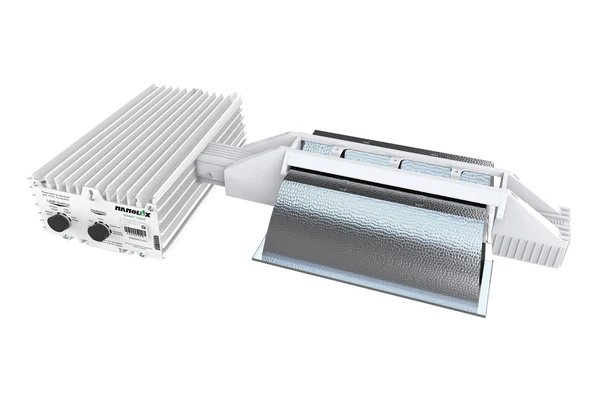
The Nanolux 1000W DSP is a professional high-intensity horticultural lighting system designed for growers who require powerful and controllable lighting across larger indoor growing areas.
Built around Double Ended (DE) lamp technology and a digital ballast, the Nanolux system combines high light output with dimming, electronic protection features and compatibility with different horticultural lamp technologies.
For professional and experienced indoor growers, it represents an interesting alternative to both conventional single-ended HPS systems and modern LED grow lights.
What is the Nanolux 1000W DSP?
The Nanolux 1000W DSP is a digital horticultural lighting system built around a high-frequency electronic ballast.
One of its major advantages is flexibility.
Depending on the specific configuration, Nanolux’s 1000W horticultural systems can operate different lamp technologies including:
- HPS – High Pressure Sodium
- MH – Metal Halide
- CMH – Ceramic Metal Halide
- Double Ended horticultural lamps
This gives growers the ability to adapt their lighting configuration to different cultivation requirements instead of being restricted to a single lamp technology.
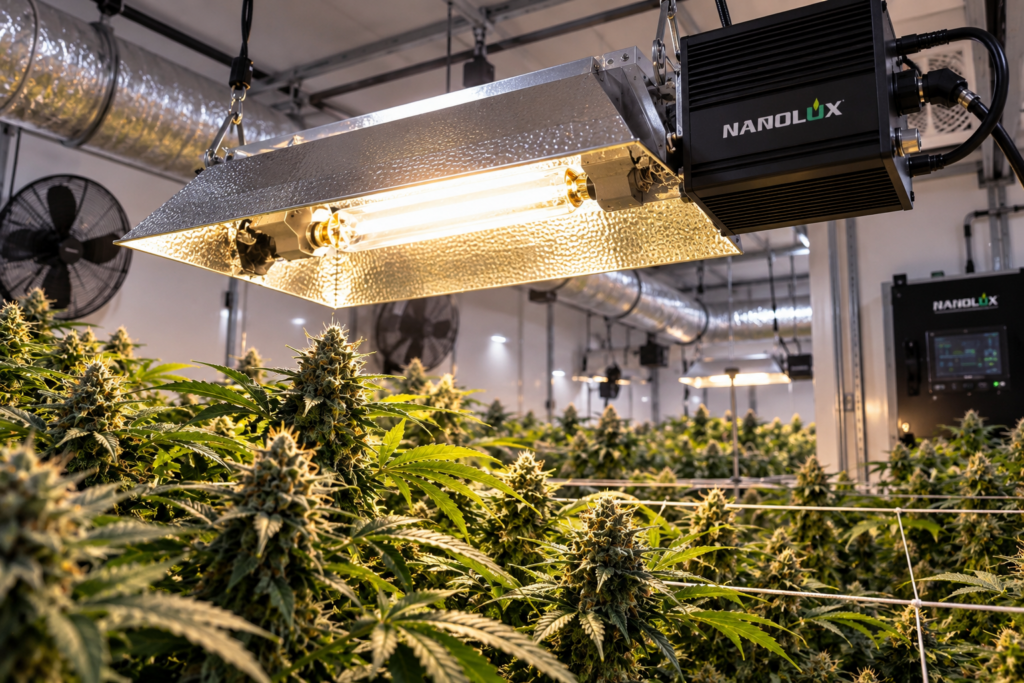
The system is particularly suited to larger indoor grow rooms where high light intensity and good canopy penetration are required.
Powerful 1000W DE HPS performance
When operated with a 1000W Double Ended HPS lamp, Nanolux specifies a photosynthetic photon flux of approximately 2,100 μmol/s for its current 1000W horticultural fixture.
That corresponds to an efficiency of approximately 2.1 μmol/J, although actual performance depends on the lamp and configuration being used.
Double Ended HPS technology also provides excellent canopy penetration.
This remains one of the reasons why high-output DE fixtures continue to be used in professional horticultural installations despite the rapid development of LED technology.
Designed for an approximately 5 × 5 ft lighting grid
Nanolux designed its DE fixture around approximately a 5 × 5 ft cultivation grid, equivalent to roughly 1.5 × 1.5 metres.
In commercial installations, however, fixtures are normally designed as part of an overlapping lighting grid rather than treating each fixture as an isolated light source.
Fixture spacing, hanging height and required intensity depend on the crop, room geometry and environmental conditions.
This is particularly important with a 1000W system because of the intensity and heat generated by high-power HID lighting.
Adjustable power output
One of the biggest advantages of a digital ballast is that the fixture does not always have to operate at maximum power.
Nanolux 1000W DE systems offer multiple dimming levels, allowing growers to reduce output when full intensity is unnecessary.
Depending on the particular generation of the fixture, Nanolux specifies settings extending from approximately 600W through 1000W, with some models offering a Super-Lux setting of up to 1200W.
This flexibility can be useful during different stages of plant development and when managing environmental conditions inside the grow room.
It can also reduce unnecessary electricity consumption when maximum output isn’t required.
High-reflectivity reflector
The reflector is another important component of the system.
Nanolux uses highly reflective aluminium material designed to distribute light across the cultivation area rather than concentrating excessive light directly underneath the lamp.
The manufacturer specifies reflector material with approximately 97% reflectivity on its DE systems.
Good reflector design matters because the goal of professional grow lighting is not simply producing as much light as possible.
The objective is delivering that light efficiently and uniformly to the plant canopy.
Digital protection systems
A 1000W horticultural fixture operates under demanding conditions, so electrical and thermal protection is particularly important.
Nanolux incorporates several electronic protection functions into its DE ballast systems, including protection against:
- excessive temperature
- overvoltage
- undervoltage
- open circuits
- short circuits
- abnormal lamp operation
The fixtures also use a soft or random-start system rather than switching an entire lighting installation to full load simultaneously.
This becomes particularly relevant in larger grow rooms containing multiple 1000W fixtures.
Ceramic DE lamp holders
Another interesting feature is the use of ceramic lamp receptacles.
High-output DE lamps operate at significant temperatures. Nanolux therefore uses industrial-grade ceramic receptacles rather than conventional plastic lamp holders.
Ceramic provides excellent heat resistance and electrical insulation and is particularly suitable for high-temperature horticultural lighting applications.
Smart grow-room control with NCCS
One of the more advanced features of the Nanolux ecosystem is compatibility with the Nanolux Cloud Control System (NCCS).
NCCS was designed to allow multiple grow-room devices to be controlled centrally.
Compatible Nanolux lighting systems can therefore form part of a larger automated cultivation environment rather than functioning simply as manually operated lamps.
Depending on the installed control hardware, lighting schedules and output can be managed centrally.
For commercial cultivation facilities containing many fixtures, centralised control can make a substantial difference to daily operations.
Nanolux 1000W DSP vs LED grow lights
The obvious question today is whether a 1000W DE system still makes sense when high-efficiency LED grow lights are widely available.
There is no universal answer.
Modern LEDs generally produce less radiant heat, offer excellent efficiency and can simplify environmental management.
However, professional DE HPS systems still provide several advantages.
They produce extremely intense light, provide strong canopy penetration and use a technology that has been proven for many years in commercial horticulture.
The equipment itself can also be considerably less expensive than some high-output professional LED systems.
The disadvantage is primarily energy and heat.
A 1000W fixture represents a substantial electrical load and produces significant heat that must be considered when designing ventilation, cooling and electrical infrastructure.
For this reason, the light should never be evaluated independently from the rest of the grow room.
Heat management matters
A 1000W horticultural light produces a substantial thermal load.
In a room containing several fixtures, that heat quickly becomes one of the primary environmental factors.
Adequate ventilation, air circulation and temperature management are therefore essential.
The electrical installation also needs to be designed for the combined continuous load of the lighting equipment and other grow-room systems.
Professional installations should always use correctly rated circuits, protective devices, cables and connections, with electrical work carried out in accordance with applicable local regulations.
Is the Nanolux 1000W DSP still relevant?
Absolutely — provided it is used in the right environment.
The Nanolux 1000W DSP represents a generation of professional horticultural lighting that combines the proven intensity of HID technology with digital control and modern electronic protection.
Its strengths are particularly apparent where growers need:
High light intensity
Strong canopy penetration
Adjustable output
DE HPS, MH or CMH flexibility
Centralised lighting control
Reliable equipment for larger cultivation areas
LED technology has changed indoor cultivation considerably, but that does not automatically make professional DE systems obsolete.
For growers who already have the necessary ventilation, cooling and electrical infrastructure, a high-quality 1000W DE fixture can still provide an extremely capable lighting platform.
Ultimately, successful indoor cultivation is not determined by wattage alone.
Light intensity, distribution, spectrum, temperature, humidity, air movement and the overall grow-room environment must work together.
The Nanolux 1000W DSP provides one powerful component of that system.
Disclaimer: This article is intended for general information about horticultural lighting technology. Always follow the manufacturer’s installation and safety instructions and applicable electrical and cultivation regulations.
Nanolux 1000W DSP
The Nanolux Summit series is a modular lighting system that allows growers to invest in a lighting fixture that can be utilized in many different applications. The backbone of the Summit system is the Summit ballast, which is the first ballast that operates a range of lamp styles and wattages with the correct lamp voltage, operation frequency and strike voltage. The Summit series is perfect as a fully-fledged indoor grow light or as supplemental lighting in a greenhouse environment.
• Operates all DE lamps between 600W-1000W (HPS, MH, CMH)
• 6 types of lamps are compatible the Summit Series: HPS 1000W, HPS 600W, MH 1000W, MH 600W, CMH 1000W and CMH 630W
• Full digital circuit ballast with maximum efficiency up to 95%: Pure aluminium alloy material is applied to help dissipate heat. Height and number of crenate coolers (heat dissipation) are calculated accurately by thermodynamically technology. Products undergo rigorous testing to keep long-term safety and stability.
• Soft start and random start technology guarantee that it will not cause a burden on the grid when multiple lights are plugged into the same power grid.