South Africa’s Hemp & Cannabis Industry Growth: Policy, Opportunities & Global Impact
South Africa is steadily positioning itself as a rising force in the global hemp and cannabis industry. By leveraging its natural agricultural advantages and the growing momentum of private sector investment, the country is transitioning toward a fully regulated, economically driven market. This evolution focuses on aligning legislation, strengthening local cultivation, and unlocking export opportunities—while maintaining a strong emphasis on public health and safety.
A Policy Turning Point
A major milestone came during the 2025 State of the Nation Address, when President Cyril Ramaphosa declared: “We want South Africa to lead in the commercial production of hemp and cannabis.”
This statement signaled a clear shift from informal, small-scale cultivation to a structured and regulated industry with large-scale ambitions.
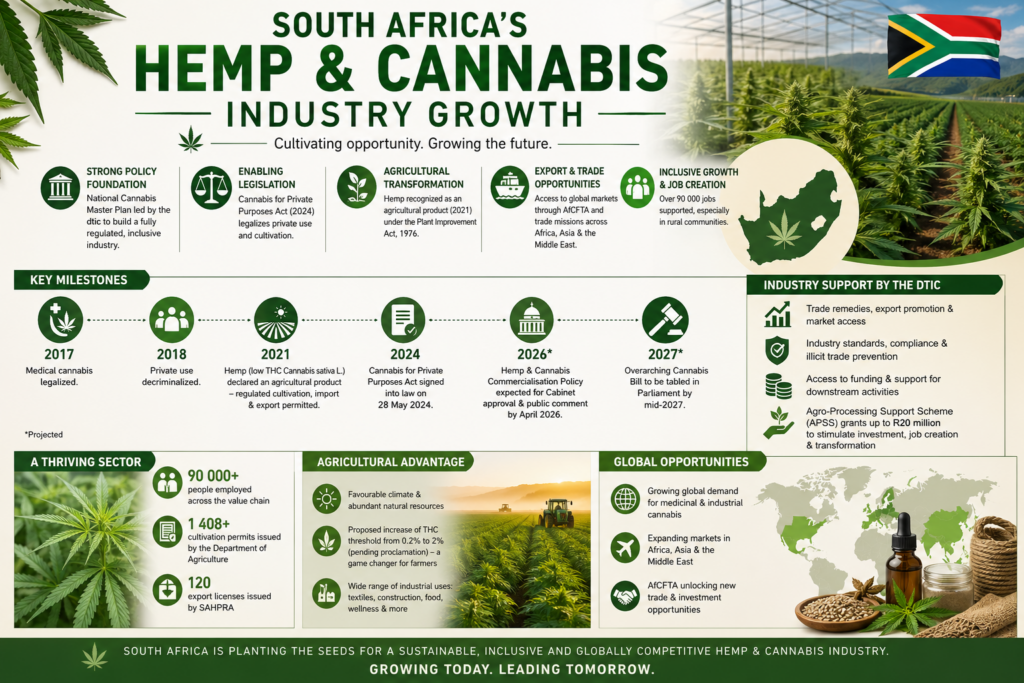
To support this vision, the National Cannabis Master Plan has been placed under the leadership of the Department of Trade, Industry and Competition (the dtic). The goal is to centralize policymaking, accelerate implementation, streamline licensing processes, and build an inclusive commercial ecosystem.
Strengthening Legal Foundations
Recent legislative developments are laying the groundwork for long-term growth. The Cannabis for Private Purposes Act, signed into law in 2024, legalized private cultivation and use. However, commercial trade still faces regulatory challenges, though progress is ongoing.
A comprehensive Hemp and Cannabis Commercialisation Policy is expected to reach Cabinet review and public consultation by April 2026. In parallel, an Overarching Cannabis Bill is being developed to unify all existing regulations—covering private use, commercial cultivation, manufacturing, and research—with a planned presentation to Parliament by mid-2027.
Agricultural Transformation and THC Reform
A pivotal shift occurred in October 2021, when hemp (low-THC Cannabis sativa L.) was officially recognized as an agricultural crop under the Plant Improvement Act. This enabled regulated cultivation, import, and export—provided producers meet licensing requirements.
Historically, South Africa enforced a strict THC limit of 0.2%, one of the lowest globally. However, due to environmental factors such as intense sunlight increasing THC levels naturally, authorities have proposed raising the threshold to 2% under the updated Plant Improvement Act (pending proclamation).
This proposed change could significantly benefit farmers by making compliance easier and expanding industrial applications—from textiles to construction materials.
Expanding Medical Cannabis and Industry Support

South Africa’s medical cannabis sector is already well established. Since legalization in 2017, the South African Health Products Regulatory Authority has issued around 120 export licenses, while the Department of Agriculture has granted over 1,400 cultivation permits—clear indicators of government backing.
The dtic, under the leadership of Minister Parks Tau, is actively supporting the industry through:
- Export promotion and trade agreements
- Development of industry standards and compliance systems
- Efforts to combat illicit trade
- Funding access for downstream processing
One key initiative, the Agro-Processing Support Scheme (APSS), offers grants of up to R20 million to stimulate investment, job creation, and sector transformation.
Global Trade and Economic Impact
Through international trade missions and agreements like the African Continental Free Trade Area, South Africa is expanding its reach into global markets across Africa, Asia, and the Middle East.
According to dtic Director-General Simphiwe Hamilton, the hemp and cannabis sector is particularly important due to its strong employment potential. Already, the industry supports over 90,000 jobs—many in rural communities where economic opportunities are often limited.
A High-Growth Industry with Strong Foundations
South Africa’s favorable climate, increasing global demand for medicinal cannabis, and strategic government initiatives like the National Cannabis Master Plan are driving rapid sector growth.
Key milestones include:
- Medical cannabis legalization in 2017
- Decriminalization of private use in 2018
- Enactment of the Cannabis for Private Purposes Act in 2024
Together, these developments form a solid foundation for a thriving, export-oriented industry.
Conclusion
South Africa is on a clear trajectory toward becoming a global leader in hemp and cannabis production. While regulatory challenges remain, the country’s coordinated policy efforts, agricultural strengths, and growing international partnerships are paving the way for a sustainable and inclusive industry.
As legislation continues to evolve and commercialization gains momentum, South Africa is not just entering the global cannabis market—it is shaping its future. South Africa is Positioning Itself as Rising Leader in Global Hemp and Cannabis Industry Website : https://www.thedtic.gov.za